

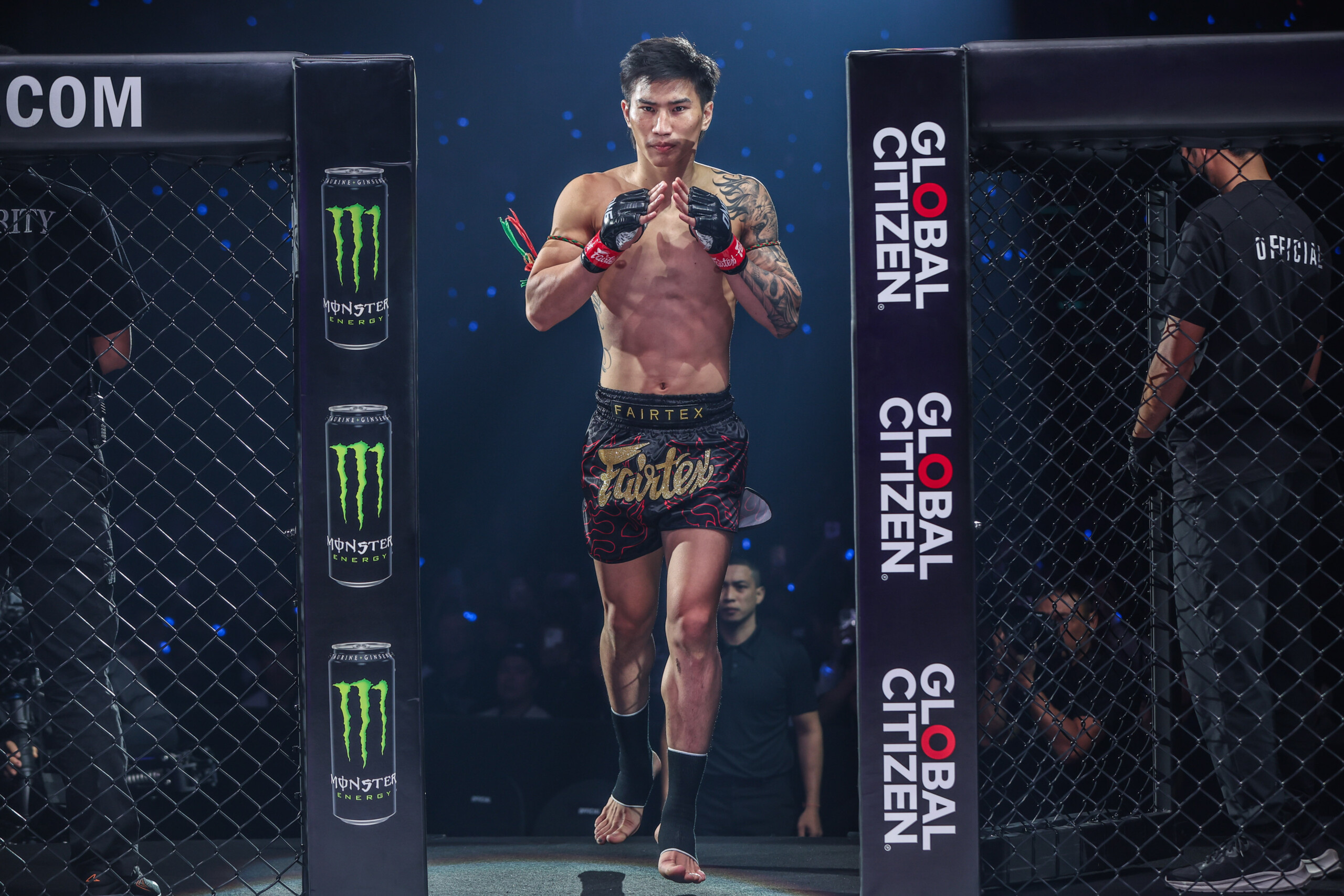
Nine months is long enough for wounds to heal but not long enough to forget how they were inflicted. Tawanchai PK Saenchai has spent that time replaying the moment his guard dropped in Saitama, when Masaaki Noiri’s punch found its mark and his kickboxing dreams momentarily went dark.
Friday evening at Lumpinee Stadium, the 26-year-old ONE Featherweight Muay Thai World Champion gets his answer to the question that’s haunted him since March: was the loss merely a stumble on an unfamiliar path, or proof that some mountains aren’t meant to be climbed?
His opponent is Liu Mengyang, a Chinese kickboxer who carries the fight name “Spirit Dragon” and possesses the kind of durable chin and heavy hands that make for dangerous Friday nights. But the real opponent, as it always is in fights like these, sits somewhere between Tawanchai’s ears — the doubt that creeps in after defeat, the whispers that perhaps kickboxing belongs to kickboxers and Muay Thai champions should stay in their lane.
“In the last fight with Masaaki, I made a mistake and got hit by his punch,” Tawanchai said.
“I don’t feel like I performed poorly. The plan was good, but he came prepared. When I threw a knee, my guard dropped, and I got caught cleanly.”
There exists a particular vulnerability in that admission — not weakness, but the honest reckoning of a fighter confronting his own fallibility. Champions in Muay Thai rarely face such moments. Tawanchai had authored six highlight-reel victories in ONE Championship, including a masterpiece against Superbon in January that cemented his status as the sport’s preeminent artist. Then came the kickboxing experiment, and with it, the education that glory in one arena doesn’t guarantee success in another.
His kickboxing record tells a story of near-excellence: a spectacular knockout debut against Davit Kiria in August 2023, a workmanlike decision over Jo Nattawut, and then the Noiri setback that threatened to derail his ambitions of becoming a two-sport world champion. Now the question becomes whether that loss represents the end of a dream or merely its most challenging chapter.
“I was deeply disappointed in myself after that fight,” Tawanchai said.
“I feel my capabilities weren’t at 100 percent, and people may feel that wasn’t the real Tawanchai. I know where the mistakes were, and I need to fix them.”
The months since have been spent in ruthless self-examination, the kind of inventory-taking that either breaks fighters or rebuilds them stronger.
Tawanchai speaks of reviewing weaknesses and strengthening defenses with the focused intensity of someone who understands that second chances in combat sports are privileges, not rights.
“I’ve been training exceptionally hard, reviewing my weaknesses, and strengthening my defense,” he said.
“I won’t go into detail, but just wait and see the improvements in this fight. Some people might say kickboxing isn’t for me, but I believe I can adapt and prove myself. No one becomes a champion instantly. You have to evolve and face challenges.”
Liu represents more than just an opponent. He’s the gatekeeper to Tawanchai’s larger ambitions. Beyond Friday’s bout looms the specter of Superbon, the reigning ONE Featherweight Kickboxing World Champion and the man Tawanchai defeated in Muay Thai.
A trilogy between them for kickboxing gold remains the fight that makes sense, the natural conclusion to their rivalry. But that path runs directly through Liu Mengyang and his reputation for durability.
The Chinese striker has done his part to add narrative spice to the proceedings, suggesting Tawanchai harbored fear. Such provocations rarely warrant serious consideration, but they serve their purpose in building anticipation.
“Liu Mengyang claimed I was afraid of him, but I know better; people say things for engagement,” Tawanchai said with the dismissive tone of someone who’s heard it all before.
“We’ll find out the truth in the ring.”
His assessment of Liu carries the tactical sophistication of a veteran studying his next assignment.
“I see Liu as a tough, durable fighter with good punching skills. That’s what’s visible right now. As for his weaknesses, you’ll have to watch the fight to find out,” Tawanchai added.
“Experience is important, and he may have an advantage there, but everything can be trained and improved. For my weapon of choice, it is still going to be that powerful left kick.”
That left kick has authored poetry throughout Tawanchai’s Muay Thai career, the weapon that’s separated consciousness from its host body with disturbing regularity. Whether it retains its potency under kickboxing’s slightly different rhythms remains Friday’s central question.
The stakes couldn’t be clearer. Another loss doesn’t just complicate Tawanchai’s path to a second world title — it potentially closes that path entirely, relegating his kickboxing career to a footnote rather than a second act of greatness.
“This fight is crucial,” Tawanchai said.
“I cannot afford to lose, as it will make my path to the kickboxing title much harder. My fans were disappointed last time, but this time, we will win together.”
There’s additional motivation beyond belts and rankings. Since his loss to Noiri, Tawanchai became a father for the first time. The responsibility of parenthood adds weight to everything else — not pressure, exactly, but perspective.
Fighting now means something beyond personal glory; it means providing, protecting, setting an example for eyes that haven’t learned to judge but will remember everything.
“This fight won’t go to the scorecards,” Tawanchai promised.
“This time, fans will see a 100 percent version of Tawanchai the kickboxer. My goal is simple: I want that second belt. That drive makes me confident that I will be the kickboxing champion next year.”
Come Friday evening, “Spirit Dragon” and the Muay Thai king will settle accounts in the ring where so many legends have been forged. For Liu, it represents the opportunity to derail a champion’s dreams. For Tawanchai, it represents something more fundamental — proof that setbacks don’t define careers, and that the path to greatness sometimes requires taking the long way around.
Nine months is long enough to heal. Now comes the part where he proves the healing took.
