

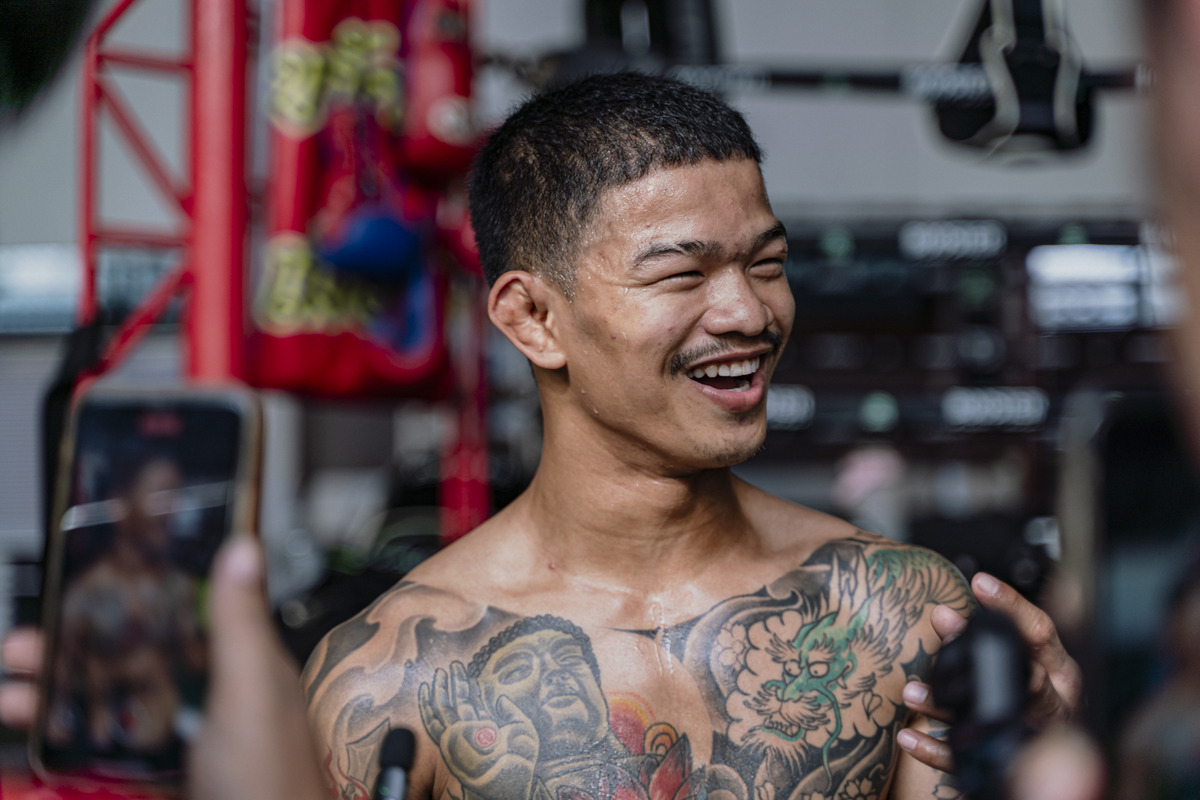
There are moments in a fighter’s career when the mirror reflects uncomfortable truths, when consecutive losses force honest conversations about whether the fire still burns or whether it’s merely embers pretending to be flame.
For Kongthoranee Sor Sommai, a two-time Rajadamnern Stadium Muay Thai World Champion with a 72-18 career record, that moment arrived after his second consecutive defeat — a streak he’d never experienced in ONE Championship’s unforgiving arena.
On Saturday, January 24, inside Lumpinee Stadium in Bangkok, Kongthoranee will attempt to prove that champions don’t become stepping stones without a fight. His opponent in this flyweight Muay Thai co-main event is Asadula Imangazaliev, a twenty-two-year-old Russian from Team Mehdi Zatout who carries a perfect 10-0 striking record and six promotional wins with five knockouts.
The stakes couldn’t be clearer at ONE Fight Night 39. Kongthoranee seeks redemption after losses to Nong-O Hama and Aslamjon Ortikov. Imangazaliev looks to continue his ascent after a spectacular head-kick knockout of Panpayak Jitmuangnon in August 2025 that announced his arrival as a legitimate threat in the division.
The mathematics of momentum work cruelly against Kongthoranee. An 11-4 promotional record speaks to his quality, but the sport cares most about recent results, and recent results tell a story of a champion in decline facing a rising star at the exact moment their trajectories intersect.
Kongthoranee speaks of his most recent defeat with the resigned honesty of a fighter who’s replayed the loss enough times to accept it without excusing it.
“Losing to Aslamjon left me disappointed and full of regret because we couldn’t secure the win. But it’s okay, I’m ready to get back up and fight again,” Kongthoranee said.
The simplicity of that statement captures the fighter’s mindset perfectly. No elaborate explanations, no complaints about circumstances, just acknowledgment and forward motion. It’s the response of a professional who understands that losses are part of the equation and dwelling serves no productive purpose.
His assessment of Imangazaliev carries the measured respect of a veteran who’s studied his opponent and found no easy answers.
“My next opponent is Asadula. His strength is definitely his speed. He’s a complete fighter with dangerous punches, kicks, knees, and elbows. It’s true his record is impressive, but I’ve lost two in a row now. I want this win badly, and I will do my absolute best,” he said.
That characterization represents the kind of opponent that tests whether a fighter in a slump can reverse course or whether the slide continues. Imangazaliev isn’t a one-dimensional threat that can be neutralized through gameplan; he’s the kind of well-rounded striker who forces opponents to be excellent everywhere or get finished anywhere.
Kongthoranee’s acknowledgment of Imangazaliev’s knockout of Panpayak reveals both the magnitude of the challenge and his awareness of how the narrative positions him.
“Asadula’s recent performance against Panpayak was incredible. That head-kick knockout was so clinical. Beating a top-tier fighter like Panpayak shows that he is far from ordinary. I’m being viewed as the underdog for this fight, which is fair. I’ve lost two straight while he’s a rising star. But this fight is my chance to prove that I still have the fire and that I can reclaim my best form,” he said.
The acceptance of underdog status matters precisely because it comes from a two-time Rajadamnern Stadium champion accustomed to entering fights as the favorite. When accomplished fighters acknowledge they’re no longer perceived as the superior competitor, it either crushes them or provides fuel. Kongthoranee seems determined to use it as the latter.
The pressure of consecutive losses creates its own particular psychology, a weight that grows heavier with each defeat until it either breaks a fighter or forges them into something more determined.
“Coming off two straight losses, I definitely feel the pressure. I’ve never lost back-to-back before. Having lost two in a row makes me never want to feel that way again. It’s become the motivation that drives me to train harder and push myself further,” he said.
That unfamiliarity with consecutive defeats provides context for why this moment feels so critical. For fighters accustomed to winning, losing streaks represent existential threats to their identity, forcing them to confront whether they’re still the fighter they believed themselves to be.
Kongthoranee’s fight prediction carries the defiance of a champion who refuses to accept the role the narrative has assigned him.
“I refuse to be a stepping stone for him. I’m giving this everything I’ve got. I don’t know who will win or lose, but I’m coming to fight 100 percent. I am determined to redeem myself. I don’t want a third loss. You’re going to see a ‘new version’ of Kongthoranee,” he said.
The promise of a new version represents the ultimate gamble for a fighter on a losing streak. Either the evolution is real and he discovers capabilities that reverse his fortunes, or it’s merely wishful thinking dressed up as transformation. Friday night will reveal which.
